Gaussian Splatting Underwater:
A Controlled Cross-Regime Study

Olaya Álvarez-Tuñón, Stella Graßhof
EIVA a/s · arXiv:2608.25483

Interactive Gaussian point clouds

Each cloud is extracted directly from a trained 3DGS model: every Gaussian contributes one point at its centre, coloured by its base (SH degree-0) colour. Gaussians with opacity below 0.2 are dropped, clouds larger than 250 k points are randomly subsampled, and each cloud is centred and scaled by its robust (95th-percentile) radius for viewing. What you see is therefore the model's geometry as the optimiser committed it, including floaters and fabricated medium. It is not a rendered image.

    drag to rotate · scroll to zoom · right-drag to pan
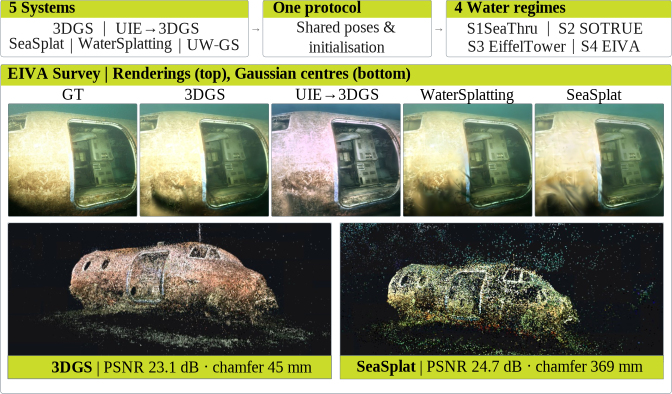
    Five code-available Gaussian-splatting systems run under one protocol across four water regimes; on the EIVA survey scene vanilla 3DGS scores lower in PSNR than SeaSplat but reconstructs far cleaner geometry.

    Abstract

    The underwater environment is challenging for 3D reconstruction, because particles suspended in the water scatter and diffuse light, turbidity varies, absorption depends on wavelength, and illumination is rarely uniform. Methods based on Gaussian splatting have generally been developed for conditions that allow good image quality, and have primarily been tested on relatively shallow water. This paper examines how well Gaussian splatting performs across publicly available underwater datasets representing different degrees of turbidity, loss of illumination, and colour attenuation, together with an industrial survey. Five systems with public code are run under one protocol, with shared poses, initialisation, budget, and evaluator, to establish their relative advantages, disadvantages, and limitations. What these methods can do turns out to depend more on the setup than on the architecture. Water clarity binds upstream of rendering, since structure-from-motion registers 99.5 % of frames in clear water and 0.0 % at 12 NTU. Illumination geometry decides whether a medium model helps at all: under an artificial light that moves with the camera, medium-blind splatting beats both medium-aware systems. On the survey the benchmark's photometric leader comes last, beaten on geometry by a restoration pre-pass in front of vanilla 3DGS—and none of it is visible in the scores the field reports. Scene builds, per-run configurations, and evaluation code are released at this repository.

    Ground truth vs. reconstruction

    Drag the divider. Left of it is the held-out ground-truth frame, right of it the same view rendered by the selected system. Every image is a real held-out test view, never a training frame.

    Held-out ground-truth frame
    The same view rendered by the selected system
    Ground truth

    Held-out renders across the four regimes

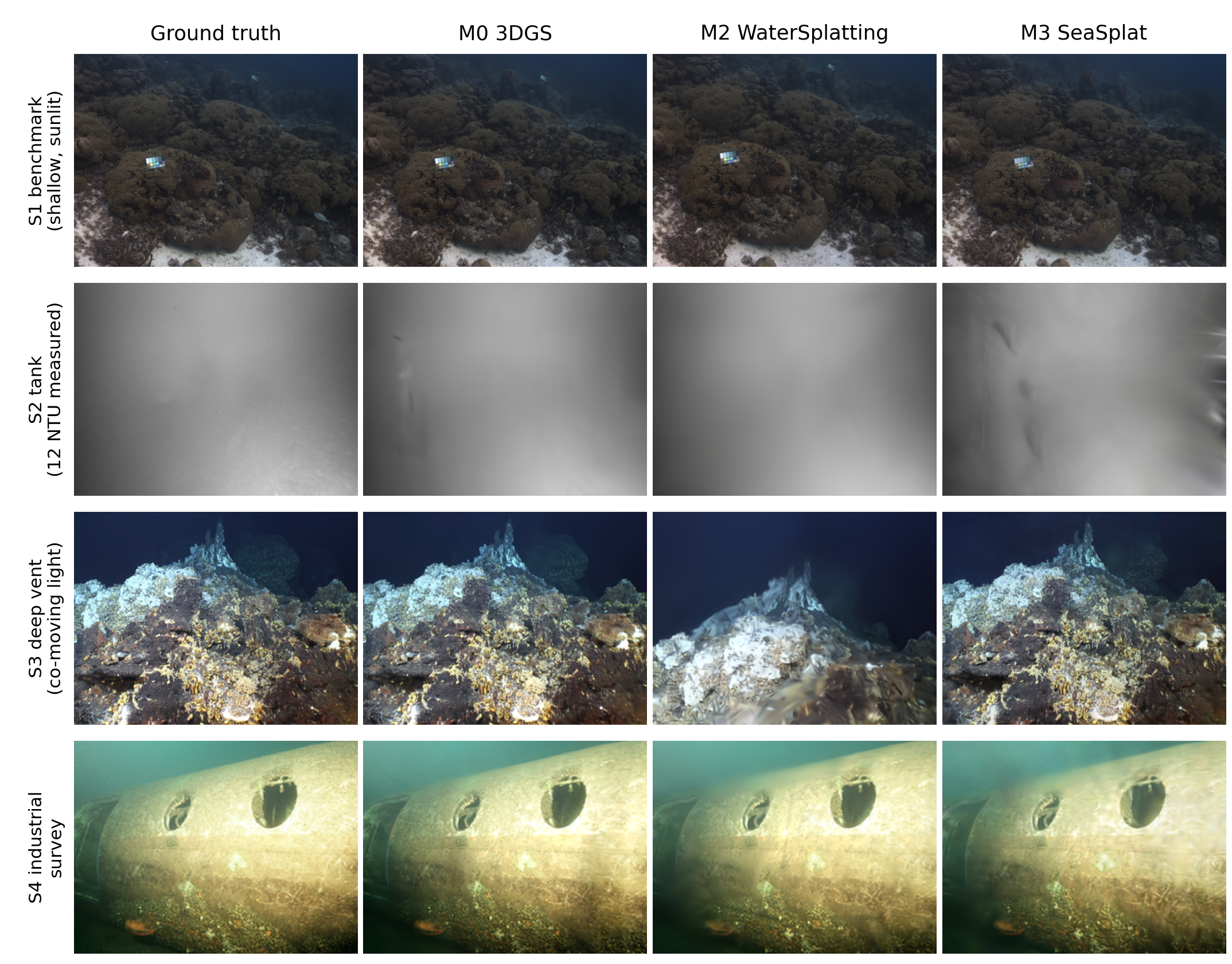
    Qualitative grid: ground truth vs M0/M2/M3 across four regimes

    Ground truth beside vanilla 3DGS (M0), WaterSplatting (M2) and SeaSplat (M3) on one held-out view per regime. On the benchmark all systems are near-indistinguishable; at 12 NTU every system renders fog; under co-moving light the medium-blind baseline wins; on the survey scene the benchmark leader is visibly hazier.

    Turbidity dose–response

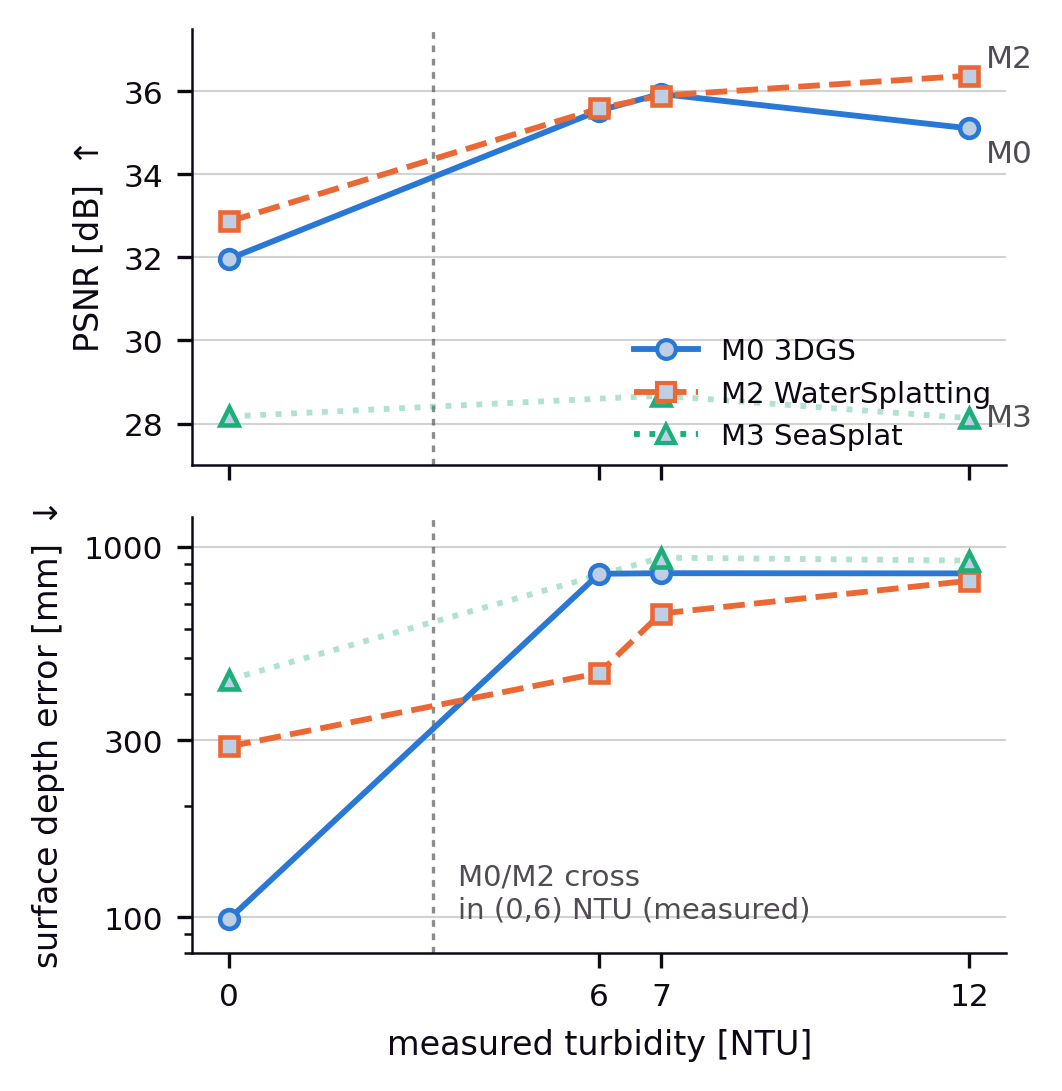
    PSNR rises with turbidity while surface error collapses

    Identical trajectory, encoder ground-truth poses, shared initialisation; only measured turbidity varies. PSNR (top) rises while surface depth error against an independent stereo reference (bottom) grows by up to 8.5×; the medium-blind/medium-aware error curves cross below 6 NTU.

    Findings at a glance

    • Registration cliff. COLMAP registers 99.5 % of frames at 0 NTU, 1.0 % at 7, 0.0 % at 12. A cliff, not a slope, and every published benchmark sits below it.
    • PSNR saturates. A per-pixel median of the training images gains +7.5 dB from turbidity; every model's margin over it shrinks as water worsens.
    • Three failure mechanisms. Vanilla splatting reconstructs haze as a solid; a separate medium field absorbs the scene (154 k → 3.1 k gaussians); per-gaussian analytic models densify until 24 GB of VRAM saturates.
    • Rank inversion. The benchmark's PSNR leader is last on both axes of the operational survey scene; a fixed 2D restoration pre-pass + stock 3DGS wins its geometry (45 mm chamfer).
    • Medium parameters aren't water properties. They flip off under linearised input (−6 dB, veil moves into the gaussians), lose 9 dB across sites, and partly memorise the particulate realisation (exposed by replaying an identical trajectory in freshly mixed water).

    Reproduce

    Everything behind the paper is in the repository: experiments/runs/ holds every run's metrics, geometry evaluations and floater sweeps; experiments/scenes/ the scene provenance (pose conventions, measured NTU); experiments/tools/ the full pipeline (scene builders, the unified evaluator, the run driver and every figure generator). experiments/SETUP.md documents the shared environment and each upstream code fix; experiments/DATA.md lists the datasets (SeaThru-NeRF, SOTRUE, Eiffel Tower) and how each scene was built.

    BibTeX

    @misc{alvareztunon2026gaussian, title = {Gaussian Splatting Underwater: A Controlled Cross-Regime Study}, author = {{\'A}lvarez-Tu{\~n}{\'o}n, Olaya and Gra{\ss}hof, Stella}, year = {2026}, eprint = {2608.25483}, archivePrefix = {arXiv}, primaryClass = {cs.CV} }